Every project we take on raises the same question when it comes to furnishing: where do we spend, where do we source off the shelf, and where does custom make the most sense?
The answer is never the same twice. But our Niagara project, a complete overhaul of a downtown condo for clients downsizing from the country to a city pied-à-terre, is one of our clearest examples of custom furniture doing exactly what it's supposed to do: solving problems no catalogue could.
The Starting Point: A Builder-Grade Condo
When we first walked through, the space was a builder-grade blank slate in every sense. Concrete ceilings, cold wood floors, white kitchen, white walls. A classic grey and white box with low-quality finishes and a layout that wasn't working. The kind of condo that feels transient by default, like nobody has really decided to live in it yet.
Our clients brought a significant contemporary art collection, a clear sense of how they wanted to feel in the space, and a desire for something warm, personal and genuinely livable. A pied-à-terre, yes, but one that felt like a real home rather than a hotel room nobody had styled yet.
The art became our north star. Large-scale, contemporary and spanning a full range of mediums, it was the most immediate source of colour and personality in an otherwise neutral shell. Every layout decision, furniture placement and accent lighting choice was made in relationship to it.
The Custom Banquette: Designed Around a Plumbing Problem
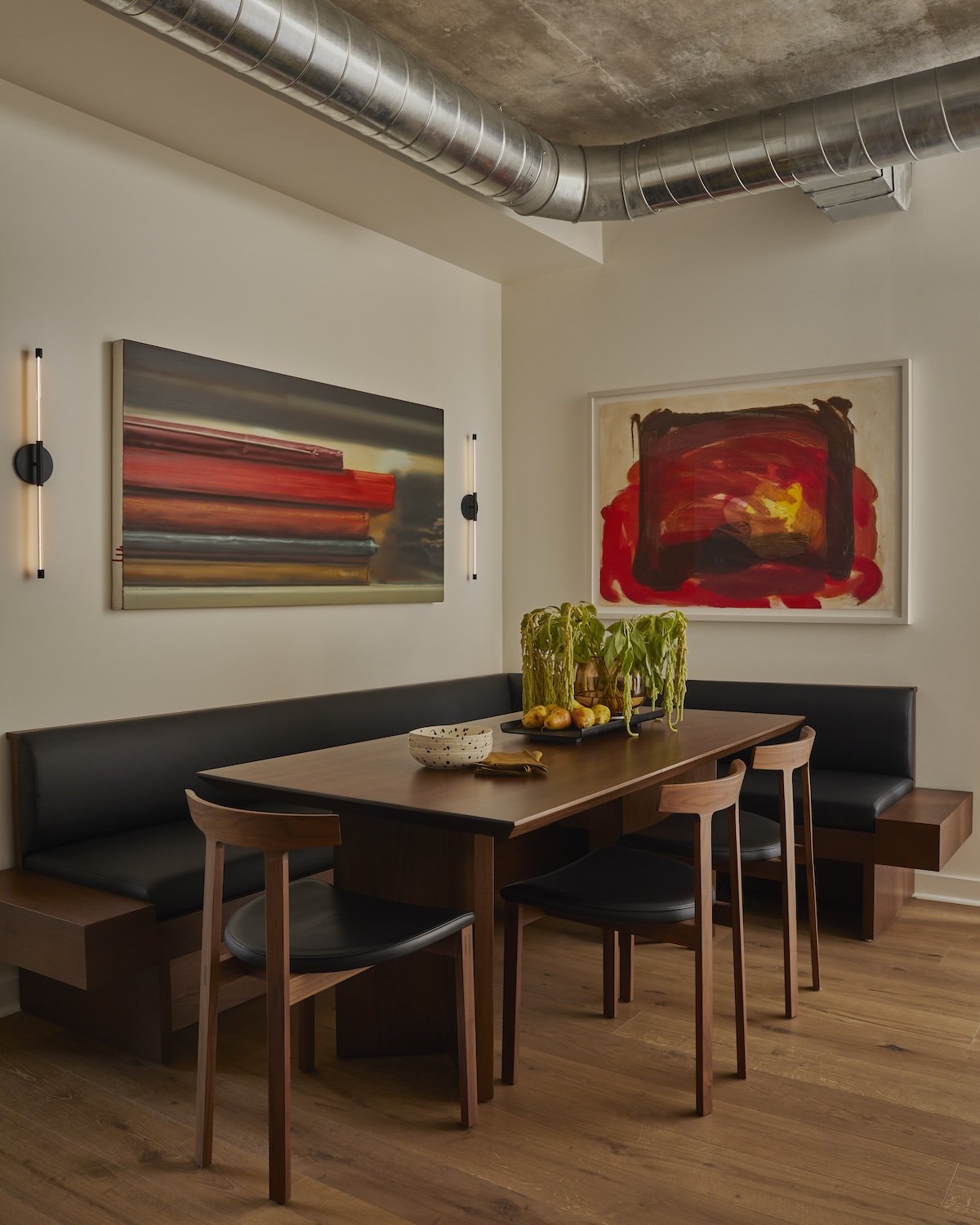
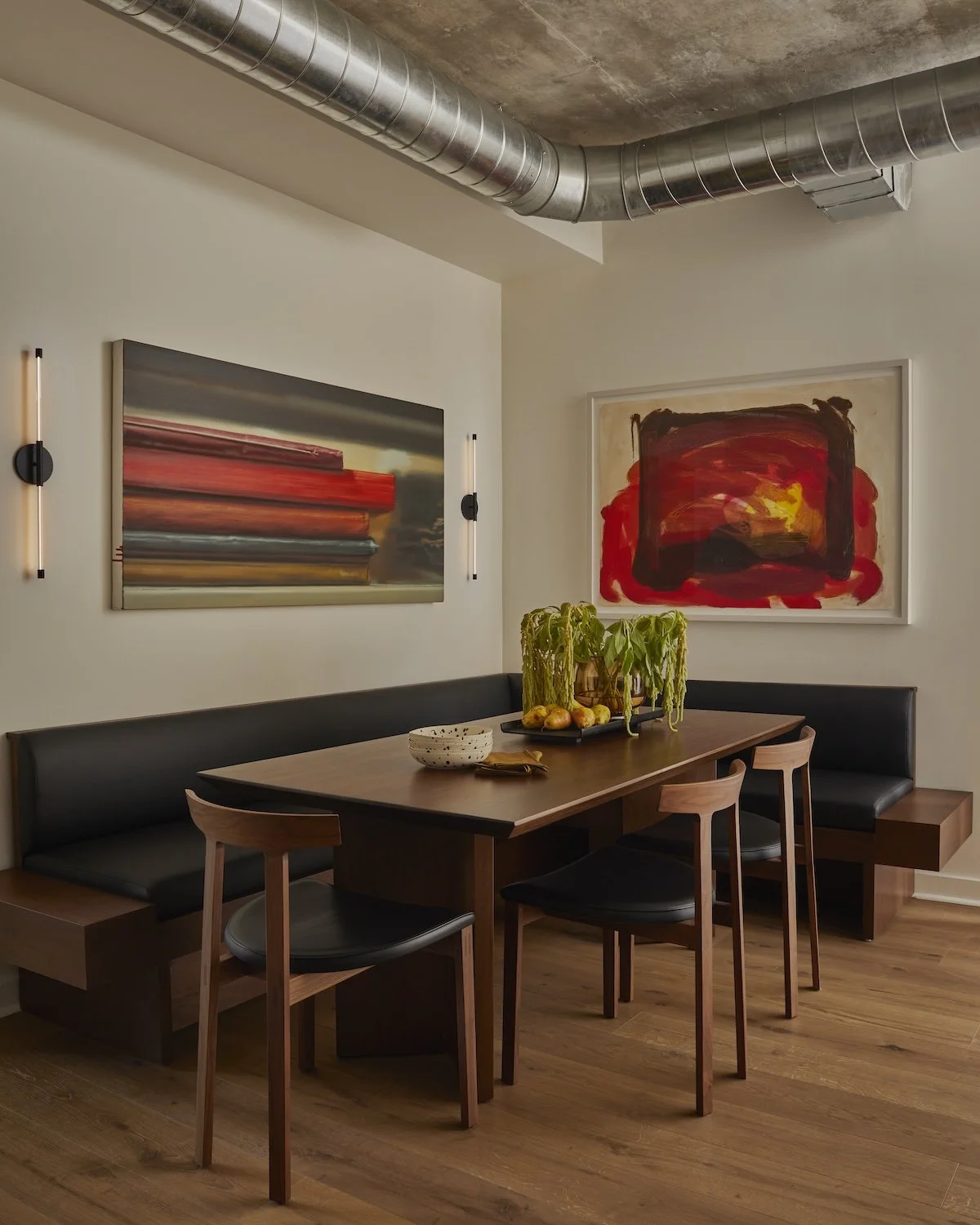
The L-shaped banquette and the table designed alongside it. Legs placed so everyone can slide in and out without a struggle.
Converting the powder room into a full three-piece bathroom, and reorienting it to sit less obtrusively in the middle of the space, freed up room for a proper dining area. But in a condo you work around concrete, and moving water lines that run through a concrete pad isn't an option.
That left us with a plumbing elbow in exactly the wrong place.
The solution was a custom banquette that hides the elbow inside the kick below the bench. It's invisible in the finished space, a detail most people would never think to look for. We would have chosen a banquette here regardless, since in a tight footprint it almost always beats freestanding chairs on all sides. The plumbing just shaped exactly how it was built.
The banquette is L-shaped, designed to feel like a proper furniture piece rather than a built-in, and finished to match the dining table we designed alongside it.
The Custom Dining Table
Seating six comfortably in a condo dining area takes precision. Leg placement with an L-shaped banquette is its own specific problem: get it wrong and nobody can sit down or get up without a struggle. We designed the table from scratch with tapered edges, generous legroom and a finish that ties directly to the banquette and dining chairs. Streamlined and considered in every dimension.
The Custom Record and Bar Cabinet: Colour as a Design Tool
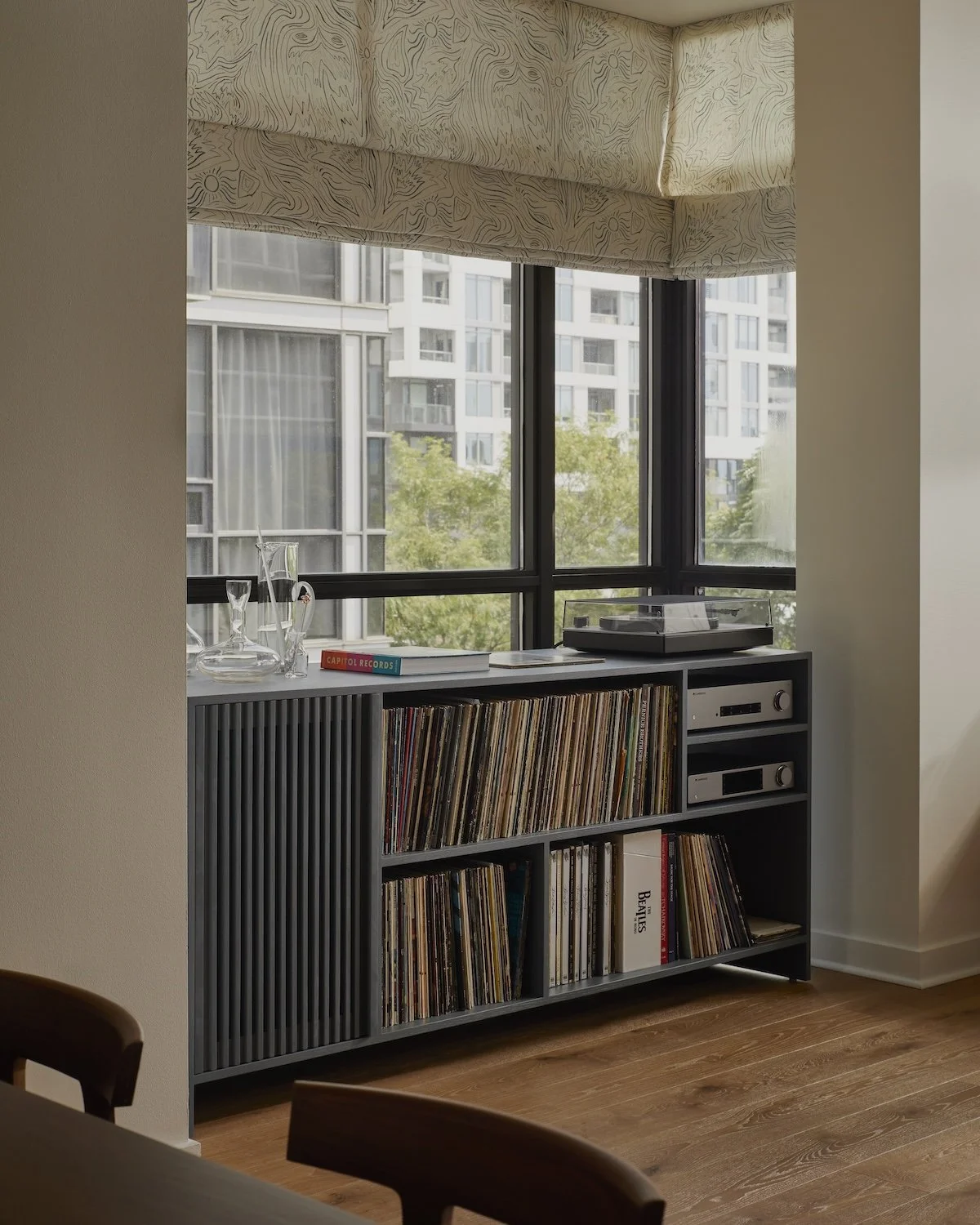
The next custom piece was a record and bar cabinet, designed to fit precisely within an existing window well and do the specific job our clients needed.
Custom bar cabinets exist, but not this one. It needed to be an exact dimension, hold a specific number of records calculated to the linear foot, store glassware at one height and bottles at another, and do it all in a colour that added personality without competing with the art.
That colour is a cool grey-teal blue, built from Benjamin Moore Nocturnal Gray as the starting point for the stain. It was our suggestion, and one we pushed for. It was the right call. It pulls from elements elsewhere in the room, complements the surrounding art, and gives the piece a presence natural wood or white paint never would have. It's the kind of colour decision you can't make from a catalogue: you need to know the whole room to know it's right.
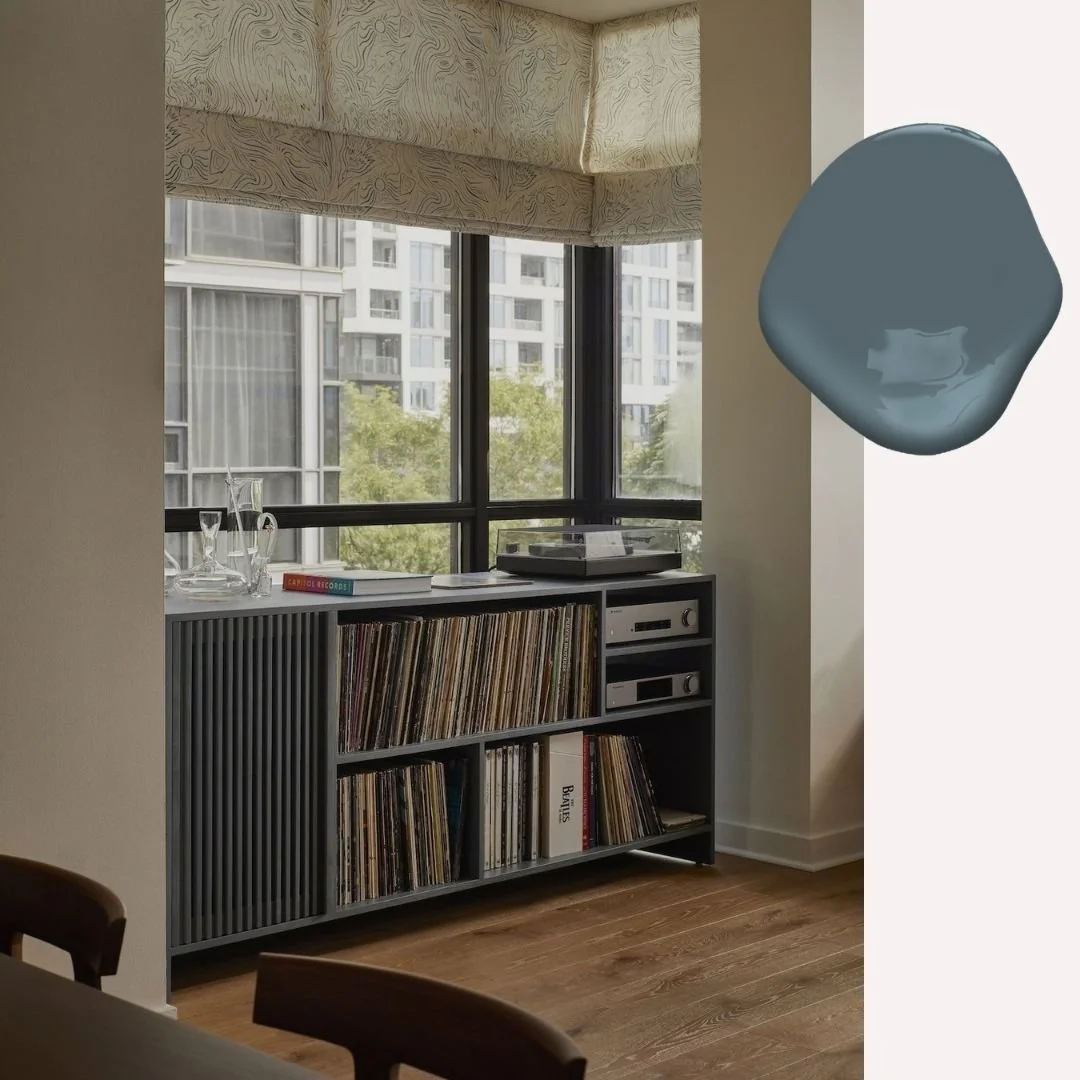
Built into the window well, records sized to the linear foot, in a grey-teal blue stained from a Benjamin Moore Nocturnal Grey base.
The same piece on paper. 78-1/4 inches wide, reeded drawer front, adjustable interior shelving, ash veneer.
The Custom Headboard: Hotel Feel Without the Anonymity
The final fully custom piece (and by fully custom we mean designed from scratch, not adapted from an existing silhouette) is the bedroom headboard.
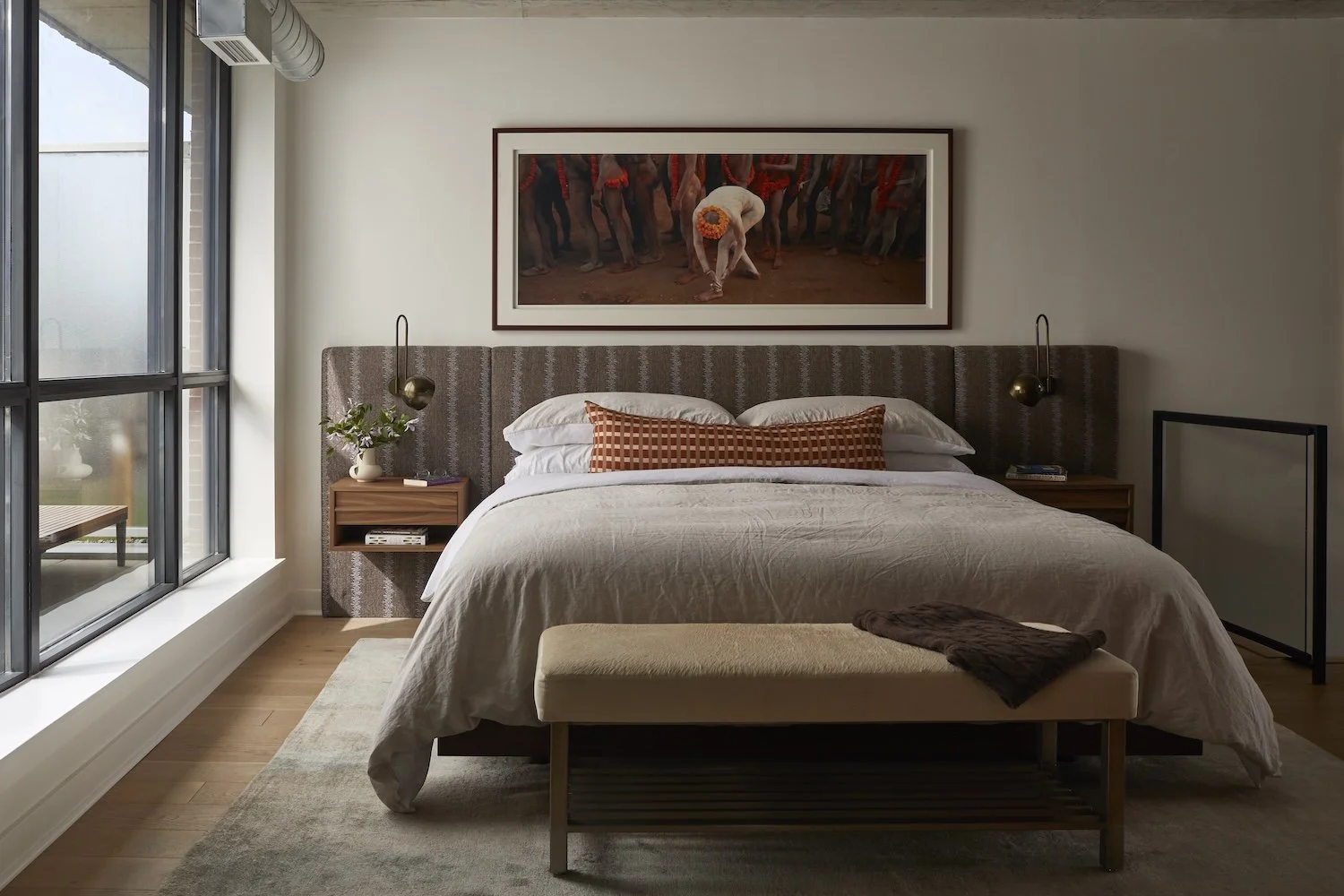
From early on we knew the bedroom needed to feel like an oasis. A downtown pied-à-terre should give you the sense you've arrived somewhere considered, even if you're only there for a few nights. Nothing gets you there faster than a wall-to-wall headboard with integrated nightstands and built-in lighting. It's a hotel reference, but it feels personal rather than anonymous because every dimension and fabric decision was made for this specific room.
The fabric is from Memo Showroom, a pattern that let us use textile as a genuine design element rather than an afterthought. At this scale, the fabric reads across the whole room, not just at the bed.
The headboard on paper. 135 inches wide, wall mounted, with sconce and outlet cut-outs drawn in from the start.
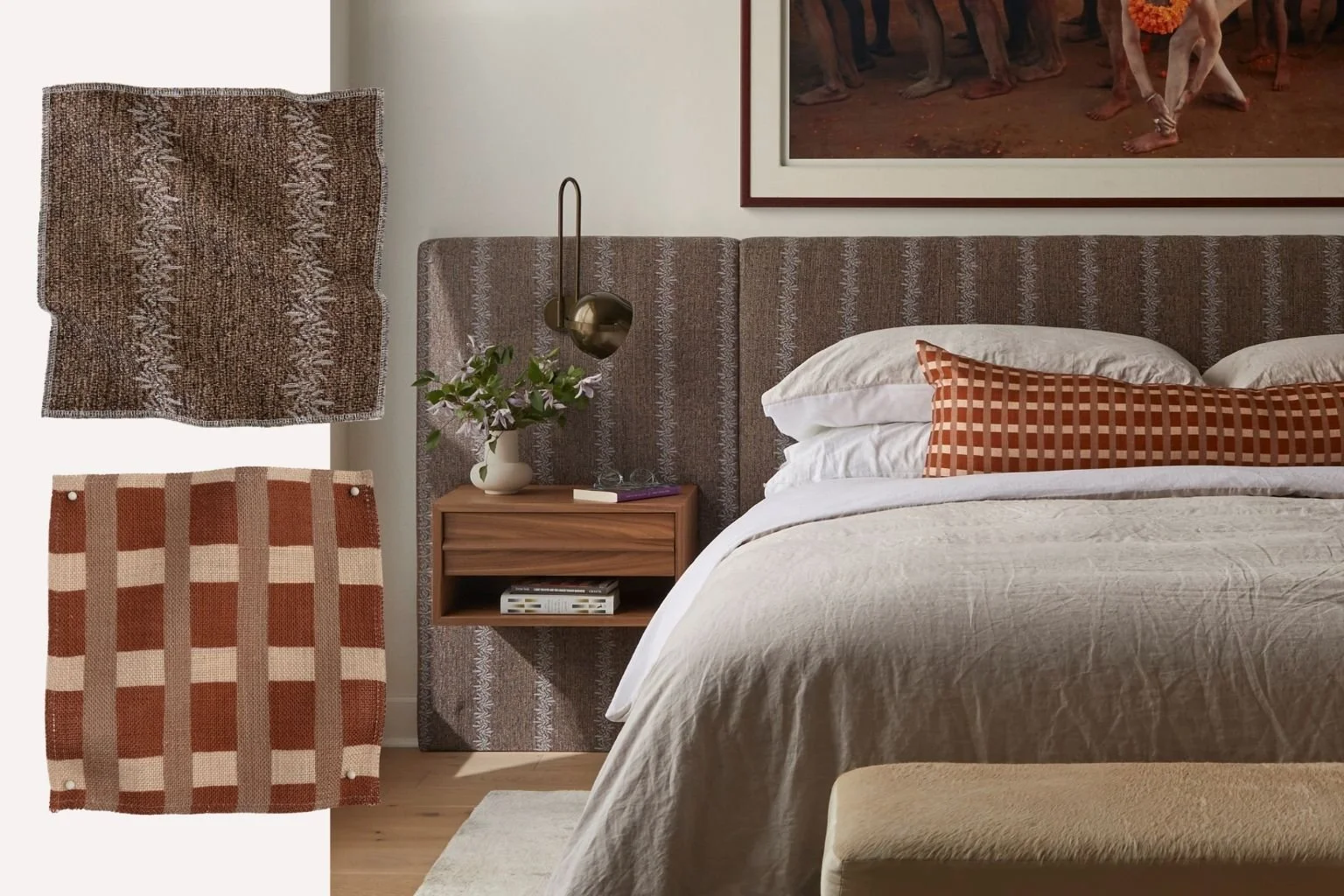
Ferrick Mason's Anne in Pepper Periwinkle across the headboard, Imogen Heath's Arty Check in Brick on the lumbar.
Why Custom Furniture? How We Decide
We establish the furniture and fixture budget on day one of every project. From there, our job is to allocate it wisely, which almost always means a mix of off-the-shelf retail, made-to-order and fully custom pieces.
Custom is not always the answer. There are extraordinary furniture designers and manufacturers whose pieces are beautiful, refined and the product of a specialty we respect. Custom doesn't replace or compete with that. If a better option exists off the shelf, we will find it and use it.
Custom earns its place when:
The space has constraints a standard piece can't solve
The design calls for something specific that simply doesn't exist
The cost is comparable to, or less than, a high-end catalogue piece (which happens more often than people expect)
In a condo, the case for custom is especially strong. The footprint is fixed, the sightlines are tight, and every piece needs to earn its place spatially as well as aesthetically. In a space that starts as a cold, generic shell, custom furniture is one of the most powerful ways to add personality that feels built in rather than placed.
This project checked every box. So we leaned in.
When Is Custom Furniture Worth It?
The question we always ask before going custom is simple: does a better option already exist?
If it does, we find it. If it doesn't, we design it. The Niagara project was full of problems the furniture market couldn't solve. Custom wasn't a preference here. It was the answer.
Read more about this project:
Niagara was featured in Toronto Life. Read the full feature here.
YOU MIGHT ALSO ENJOY